We regularly receive the same question from people in career transition or wellness practitioners who want to expand their offerings: where exactly does the boundary lie between authorized services and acts reserved for holders of the CAP in aesthetics? The answer depends less on the type of treatment than on the nature of the gesture performed and the vocabulary used to market it.
Risk of reclassification by the DGCCRF: the closing gray area
Many practitioners without a diploma in aesthetics rely on a simple logic: as long as one does not claim to heal, one can offer the treatment. The update of the DGCCRF FAQ on February 19, 2026, tightens this interpretation.
The text specifies that a treatment can be offered without a CAP in aesthetics only if it has no therapeutic aim, no medical aim, and no action that presents a proven risk to health. In practical terms, no manipulation of radiation devices, no skin penetration, no promise of treatment.
The DGCCRF also notes a recent increase in inspections of wellness practitioners who use the vocabulary of “treatment” or “rehabilitation” in their communication. A relaxing massage becomes problematic as soon as one refers to “lymphatic drainage for decongestive purposes” on their booking page. Legal reminders and reclassifications are multiplying.
To fully understand what can be done without a CAP in aesthetics, one must think in terms of technical gestures and commercial vocabulary, not just in categories of treatments.
Beauty services authorized without a CAP in aesthetics: a concrete list
Two families of services are accessible without an aesthetics diploma, provided that the regulatory framework is respected.
Body treatments oriented towards wellness
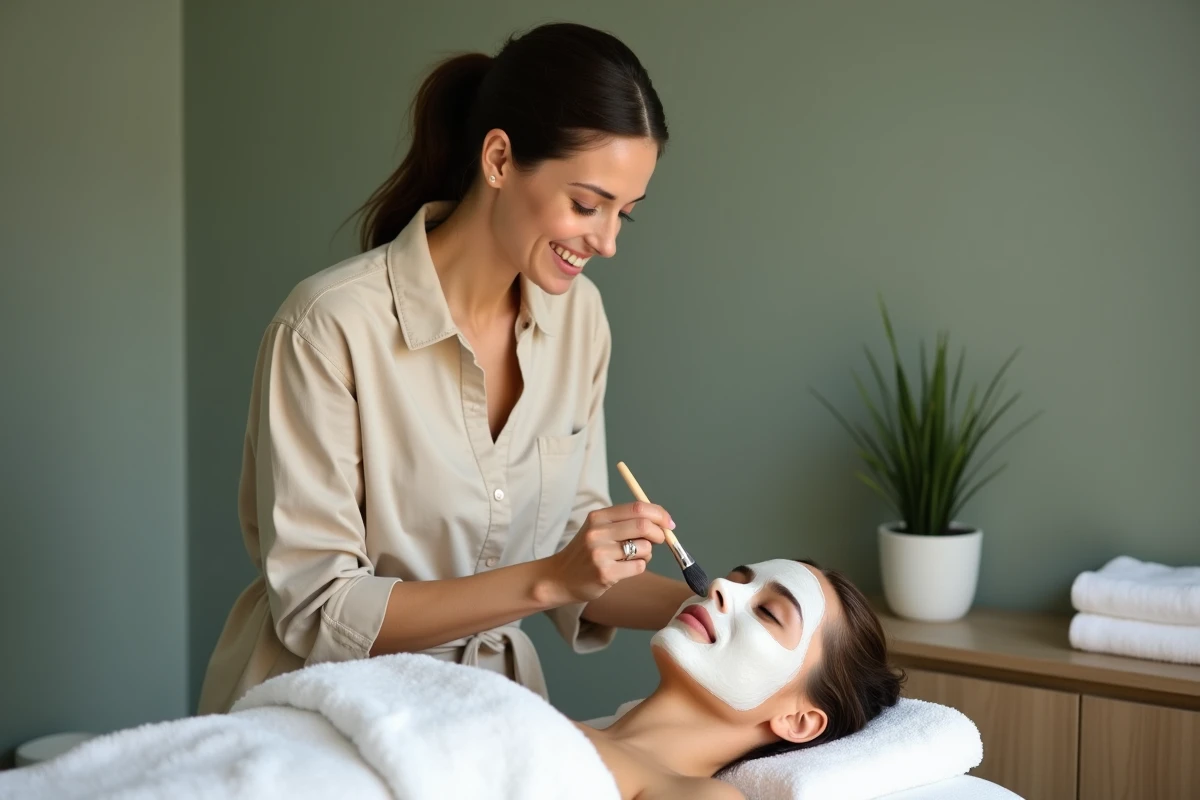
Wellness massage (Californian, hot stone, foot relaxation) remains the most common service. The gesture must remain aimed at relaxation, without therapeutic claims. Non-medical foot care (scrubbing, moisturizing, nail polish application) and scalp massages, including head spas that attract an increasing clientele, can also be offered.
Beauty enhancement services
- The application of classic and semi-permanent nail polish on natural nails, nail art, and filing do not fall under the CAP in aesthetics. The application of nail prosthetics (gel, resin) falls into this same category.
- Event makeup (weddings, photo shoots) is free to practice. One does not intervene on the structure of the skin, applying cosmetic products on the surface.
- The sale of cosmetic products, in-store or at home, does not require any aesthetics diploma. It is a classic commercial activity.
On the other hand, hair removal, facial treatments with comedone extraction, and UV tanning remain reserved for qualified professionals. The boundary is clear on these gestures.
Commercial vocabulary and reporting obligations: the field traps
On the ground, most problems do not arise from the gesture itself but from how it is presented. A practitioner offering an “anti-aging restructuring treatment” without a CAP exposes themselves to an inspection, even if the actual gesture is limited to a facial massage with a moisturizing cream.
Every word counts on the service sheet. “Relaxing modeling” is preferred over “draining massage,” “comfort treatment” over “skin treatment.” Feedback on this point varies by department, but the general trend is towards greater rigor.
Regarding status, self-employment remains the most commonly used format to start a wellness activity without a CAP. The APE code depends on the dominant service. For wellness massage, one declares as “body maintenance” and not as “beauty treatments,” the latter code being associated with regulated activities.

Short training courses to secure one’s activity without a CAP
Not having a CAP does not exempt one from training. On the contrary, a short certified training protects legally and reassures clients.
Training organizations offer modules ranging from a few days to a few weeks on wellness massage, nail prosthetics, or professional makeup. These trainings do not provide a state diploma but attest to technical competence and allow one to justify their know-how in case of inspection.
There are also specialized courses in foot beauty, bun techniques, or hair care, which complement a wellness offering well. The goal is not to accumulate certificates but to choose one or two specializations that align with the target clientele.
The case of VAE for further advancement
For those who have been practicing for several years, the validation of acquired experience (VAE) allows obtaining the CAP in aesthetics without going back through initial training. It is a lengthy process (often more than a year between the file and the jury), but it opens access to all regulated services, including hair removal and facial treatments.
Practicing without a diploma remains possible within a precise perimeter, provided that one never crosses the line of regulated aesthetic acts. The framework has tightened since the DGCCRF update in February 2026, and the trend is not going to reverse. It is better to build one’s offering around clearly positioned wellness services, with mastered vocabulary and documented training, than to navigate in a gray area that shrinks each year.